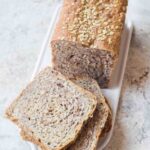
Honey Oat Nut Bread
Servings: 12 slices ( 9 x 5 loaf pan)
Calories: 233kcal
Soft and hearty honey walnut oat bread made with whole wheat flour and oats. Perfect for sandwiches, toast, and everyday baking.
Print Recipe
Ingredients
- 113 g walnuts toasted and finely chopped, or use nuts of your choice
- 240 g bread flour
- 85 g whole wheat flour plus more as needed
- 134 g quick-cooking oats NOT instant oats, plus more for topping
- 2 ½ tsp instant yeast
- 1 ¼ tsp salt
- 70 g honey
- 57 g oil
- 240 g water plus more as needed
Instructions
- If the walnuts are not toasted yet, toast them in a dry pan over medium-low heat for 5 minutes or until they are aromatic. Let them cool completely and then cut into fine pieces
If you only have rolled oats (old-fashioned oats), put them in a food processor and pulse them several times until they are broken into smaller pieces. DO NOT use instant oatmeal. It's not the same as quick-cooking oats, which is basically just rolled oats broken into smaller pieces so they cook much faster
Prepare the dough:
- Place the bread flour, whole wheat flour, quick oats, instant yeast, salt, honey, oil, and water in a mixing bowl of a standmixer. Use a dough hook to roughly stir them to combine.
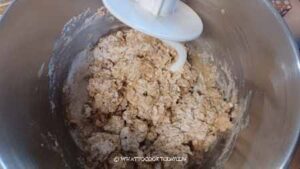
- Turn the mixer to low and knead for about 2-3 minutes and then increase to speed 4 and knead for another 5 minutes. Scrape the sides of the bowl halfway through the kneading.The dough should come together, but not smooth yet. The dough is kinda sticky and that's normal.
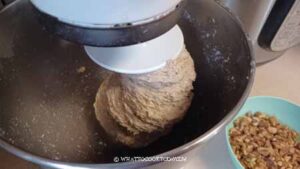
- Then add the chopped walnuts and continue kneading for another 3-5 minutes or until the dough is elastic and clear the sides of the bowl. You may need to reposition the dough and scrape the bottom of the bowl to make sure the nuts are evenly distributed. The dough is still sticky to the touch and that's normal
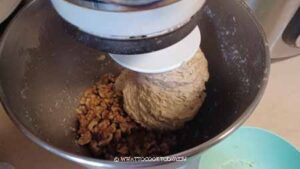
If you gently stretch a small amount of the dough thinly, it shouldn't tear easily. You are done kneading. If it tears easily, knead it a bit longer
First proofing:
- Grease a large container. Oil your hands lightly and pick up the dough and round it up into a dough ball
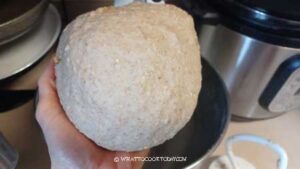
- Put the dough ball in the container and flatten the dough into the container. You can easily tell when the dough has doubled in volume. Keep it covered and proof at a warm place. It may take 1 - 1 1/2 hours, depending on the temperature
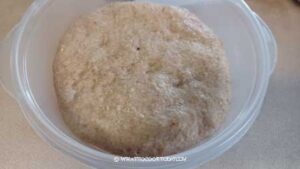
Shaping:
- You can use standard 9 x 5 inch loaf pan, which will yield shorter and wider loaf or use a small pullman pan which is 9 x 4 x 4 inch loaf pan, which yield taller loaf
- Lightly grease the loaf pan on all sides. Line with parchment paper on the long side of the pan, overhanging on the side if you want to.
- Transfer the dough to a lightly floured surface. Don't use too much flour as it can dry out the bread. The dough isn't sticky and pretty easy to work with, so you shouldn't need much flour at all
- Flatten the dough while releasing the air bubbles. Pat into a rectangular shape, roughly about 12 x 8 inches.
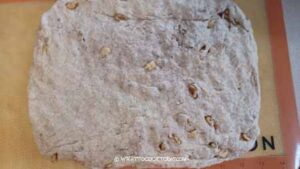
- Fold the two short side to meet at the center
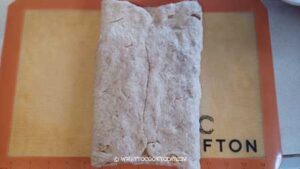
- The roll down to form a tight log
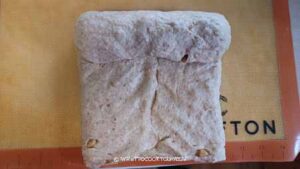
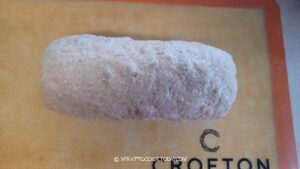
Final proofing:
- Place the log in a prepared pan. Pat the dough down to fill up the pan evenly.
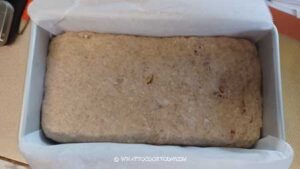
- Cover the pan with lightly greased plastic wrap, and allow the dough to rise for 1 to 1 1/2 hours, or until it crests 1 to 2 inches over the rim of the pan
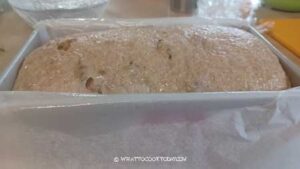
- OPTIONAL: Brush with some egg whites on top of the loaf (you can use mist with water too, but the oats stick better with egg white). Sprinkle with some oats
Baking:
- 15 minutes before the end of the final proofing, preheat the oven to 350 F (180 C) for conventional oven. For a convection oven, lower the temperature by 20 F (15 C)
- Bake the bread in a preheated 350F oven for 40-45 minutes. Start checking at around 40 minutes. The 9 x 5 inch loaf pan took about 40 minutes and the 9 x 4 x x inch loaf pan took about 45 minutes in my oven. If the bread appears to be browning too quickly, tent it with aluminium foil for the final 10 minutes of baking
If you have an instant-read thermometer, insert it into the center of the bread and it should be at least 190F.
Cooling:
- Remove the bread from the oven and loosen the bread with an offset spatula and gently grab the parchment paper and lift the bread out and place on cooling rack. This is optional, but you can brush with some melted butter on top while the bread is still warm. Let the bread cool down completely before slicing. DO NOT slice it while it's still warm. It will crumble badly
Nutrition
Serving: 1serving (out of 12 slices) | Calories: 233kcal | Carbohydrates: 28g | Protein: 6g | Fat: 12g | Saturated Fat: 1g | Polyunsaturated Fat: 6g | Monounsaturated Fat: 4g | Trans Fat: 0.02g | Sodium: 254mg | Potassium: 121mg | Fiber: 3g | Sugar: 5g | Vitamin A: 51IU | Vitamin C: 0.2mg | Calcium: 25mg | Iron: 1mg
