This post may contain affiliate links. Please read our disclosure policy.
Make soft and fluffy Chinese scallion oil hua juan with beautiful flower-shaped layers. These savory steamed buns are fragrant, delicious, and easier to make than they look.
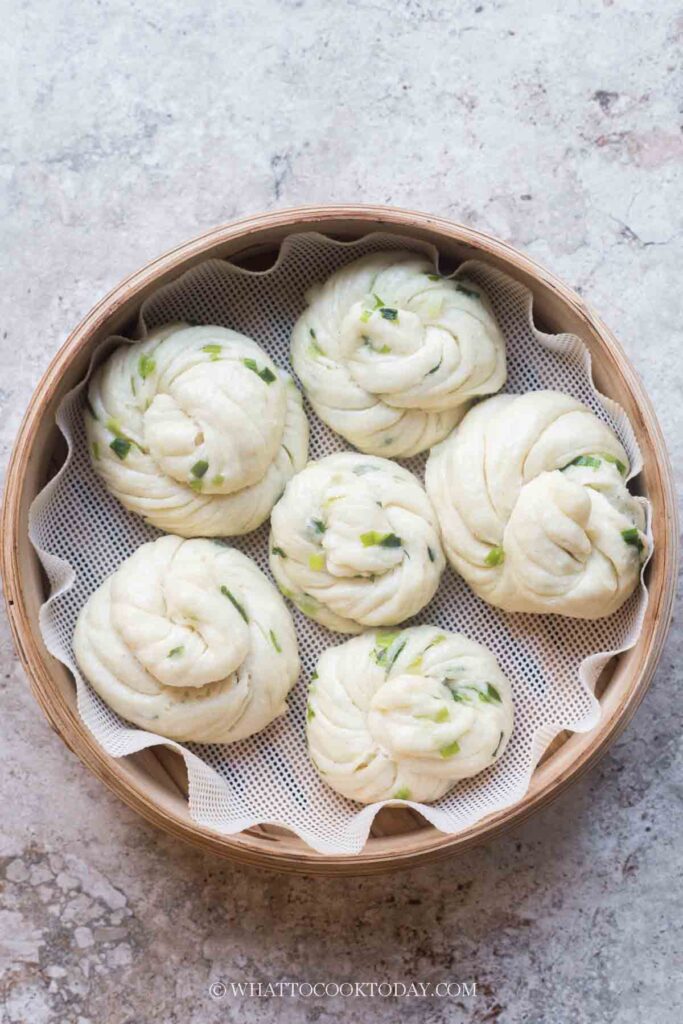
These scallion oil hua juan are soft, fluffy Chinese steamed buns with beautiful layers of savory scallion flavor. They’re made with a simple homemade scallion oil that adds wonderful aroma and flavor to every bite. If you love my popular soft and fluffy steamed buns, you’ll want to try this version!
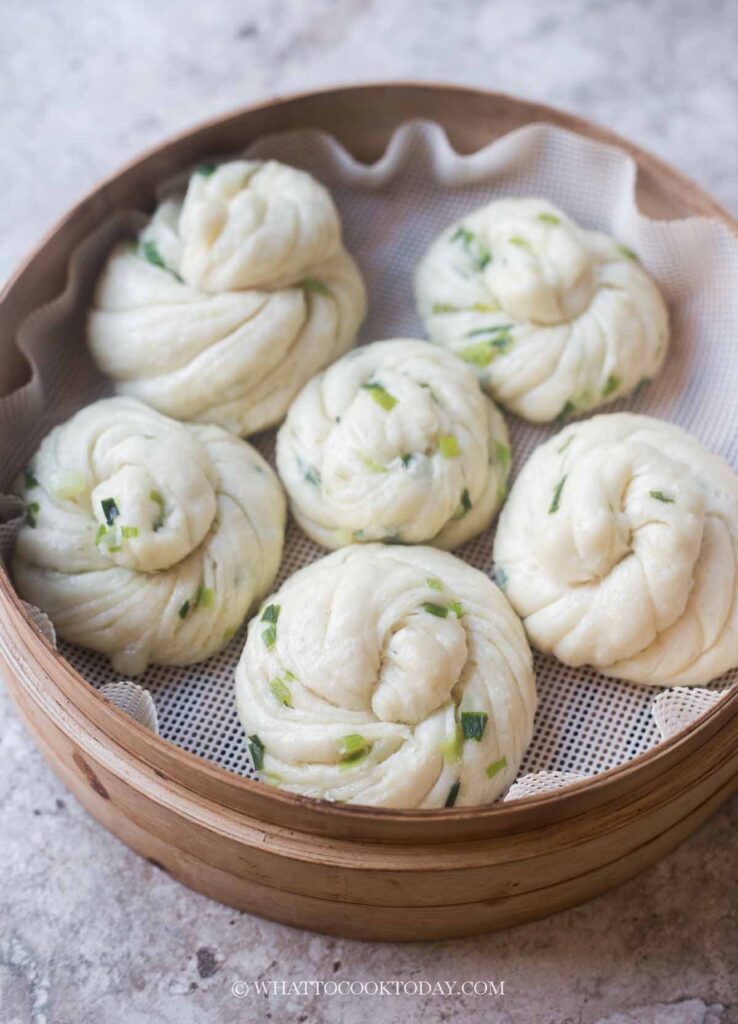
Hua Juan (花卷), which translates to flower rolls, are a type of Chinese steamed bun known for their beautiful twisted shape and savory layers. Unlike plain mantou, these buns are seasoned with ingredients such as scallions, sesame oil, or other savory fillings. They’re soft and pillowy on the inside, with delicate layers that make them especially delicious.
What is hua juan?
Hua Juan (花卷), or Chinese flower rolls, are a traditional type of Chinese steamed bread. They’re made from an enriched yeast dough that is rolled out, layered with savory ingredients, and shaped into decorative rolls before steaming.
The name comes from their flower-like appearance. There are many ways to shape hua juan, and the fillings can vary depending on the region and personal preference. Scallions are one of the most popular additions, often paired with sesame oil or other seasonings.
Unlike plain mantou, which has a simple, slightly sweet flavor, hua juan has savory layers that make it delicious even without any accompaniment.
Why You’ll Love These Scallion Hua Juan
- Soft and fluffy texture: The dough is adapted from my tried-and-true soft and fluffy steamed bun recipe.
- Fragrant homemade scallion oil: Gently cooking the green onions in oil brings out their aroma and adds flavor throughout the dough.
- Beautiful flower shape: The simple folding and twisting technique creates lovely layers without requiring any special equipment.
- Great for making ahead: You can prepare the scallion oil in advance, making the recipe easier to put together.
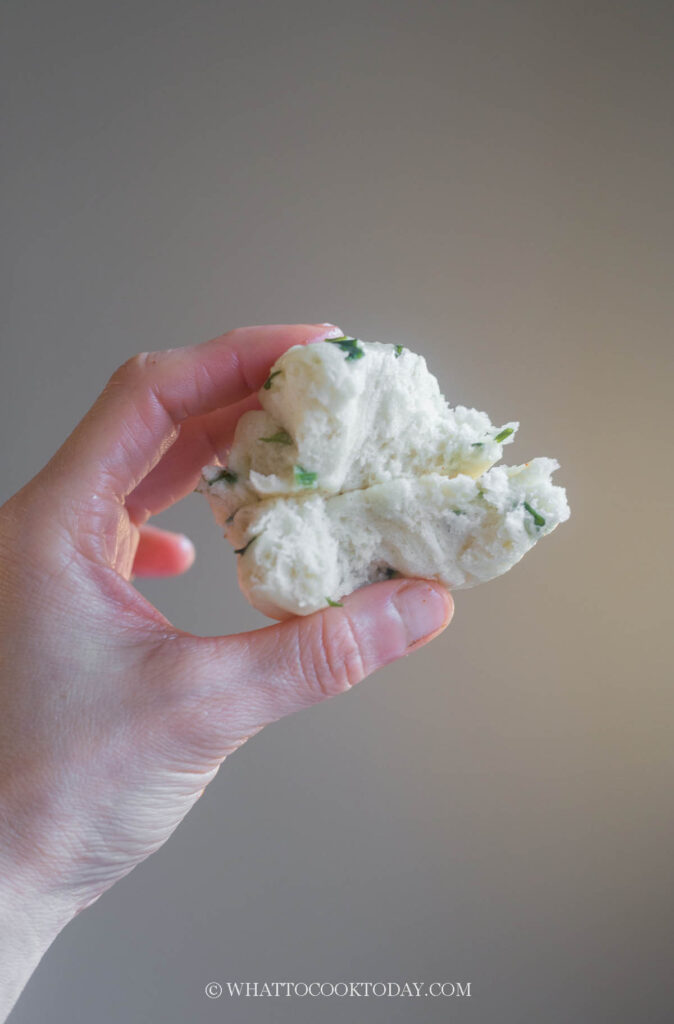
Ingredients and substitutions
- All-purpose flour: This forms the main structure of the dough and gives the buns their soft yet slightly chewy texture.
- Cake flour: I use a combination of all-purpose flour and cake flour to produce a softer, more tender steamed bun. If you don’t have cake flour, you can use all-purpose flour, although the texture may be slightly less delicate.
- Instant yeast: Helps the dough rise and gives the buns their light, fluffy texture. If using active dry yeast, dissolve it in some of the lukewarm milk first and allow it to become foamy before adding it to the flour.
- Baking powder: A little baking powder helps create a lighter texture.
- Sugar: A small amount provides food for the yeast and balances the savory scallion flavor. The buns will not taste sweet.
- Salt: Seasons both the dough and the scallion filling.
- Milk: Adds moisture and gives the dough a tender texture. Add it gradually because the amount needed can vary depending on the flour.
- Scallions: Use fresh scallions for the best flavor. Finely chop them so they distribute evenly throughout the layers.
- Cooking oil: Used to gently sauté the scallions and create the fragrant scallion oil. A neutral-flavored oil works best.
Tips for making the best hua juan
- Don’t rush the scallion oil: Cook the scallions gently over medium-low heat. You want them softened and fragrant, not browned or burnt.
- Add the milk gradually: Different brands of flour absorb liquid differently. Stop adding milk once the dough comes together into a smooth, workable dough.
- Don’t overproof: The buns only need to increase in size by about 50%. Overproofing can affect their shape and texture after steaming.
- Keep the dough covered: While shaping, cover the portions you’re not working with to prevent the surface from drying out.
Frequently asked questions
1. Can I prepare the scallion oil ahead of time?
Yes! The scallion oil is a great make-ahead component. Let it cool completely, transfer it to a clean, covered container, and refrigerate. For the best quality, use it within 2 weeks. Always use a clean utensil when scooping it out.
2. Can I make the dough by hand instead of using a stand mixer?
Absolutely! You can knead the dough by hand on a lightly floured work surface. It will take a little more effort, but knead until the dough becomes smooth, elastic, and stretchy.
3. Why didn’t my hua juan turn out fluffy?
There are several possible reasons. The dough may not have been kneaded sufficiently, the yeast may no longer be active, or the buns may have been underproofed. Make sure the dough is smooth and elastic before shaping, and give the shaped buns enough time to become noticeably puffy before steaming.
4. Why did my steamed buns shrink or wrinkle after steaming?
A sudden temperature change can cause steamed buns to shrink. Letting them rest in the covered steamer for 5 minutes after turning off the heat helps minimize this. Overproofing can also affect their structure.
5. Can I use a bamboo steamer?
Yes! A bamboo steamer works beautifully for hua juan. You can place the buns on small pieces of parchment paper to prevent sticking. Unlike a metal steamer, you don’t need to wrap the bamboo steamer lid with a towel.
Storage and reheating
- Storing at room temperature: These buns are best enjoyed fresh on the day they’re made. If you plan to eat them within a day, let them cool completely and store them in an airtight container.
- Refrigerating: You can refrigerate leftover hua juan in an airtight container for up to 3 days, although refrigeration may make the buns firmer.
- Freezing: For longer storage, freeze the completely cooled buns in an airtight freezer-safe bag or container for up to 2 months. Freeze them in a single layer first if you want to prevent them from sticking together.
- Reheating from refrigerated: Steam over medium heat for about 5–7 minutes, or until heated through.
- Reheating from frozen: You can steam them directly from frozen for about 8–10 minutes, or until thoroughly heated.
- Pan-frying: If you enjoy the crispy-bottom version, reheat the steamed buns in a lightly oiled nonstick pan over medium heat until the bottoms become golden and crisp again.
A little more about this recipe
These scallion oil hua juan are a lovely variation of classic Chinese steamed buns. I especially like how making the scallion oil transforms simple scallions into something much more fragrant and flavorful. The little twists and layers make them look special, but the shaping technique is easier than it looks once you get the hang of it.
Make a batch to enjoy fresh, or freeze some for another day. They’re the kind of savory steamed buns that are always welcome at the table!

Ingredients
Equipment
Method
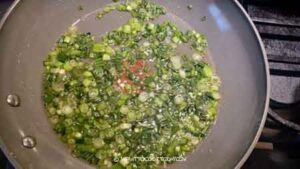
- Place the oil and finely chopped scallion on a pan over medium-low heat. Let them cook for about 5 minutes or so until the scallion pieces are soft and smell good. Remove from the heat and let them cool down. Once they have cooled down completely, cover and they can be kept in the fridge for 2 weeks
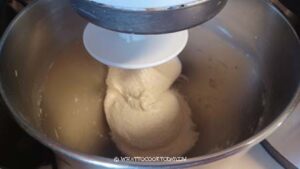
- Place all-purpose flour, cake flour, instant yeast, baking powder, sugar, 1 tsp of salt in a mixing bowl. If you are using a stand mixer, use a dough hook attachment. Gradually add milk. You may need more. Add more teaspoon by teaspoon until the dough comes together and continue to knead for 10-12 minutes until the dough is very smooth and stretchy
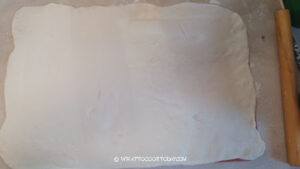
- Lightly dust your work surface. Roll the dough out into a rectangle, roughly measure about 20 x 10 inch rectangles
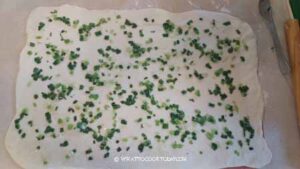
- Brush the dough surface with the scallion oil you make (you won't be using all of them). I use a fork to get the scallion pieces out of the oil. I use all of the scallion pieces. Gently spread them as evenly as possible across the dough. Sprinkle with about 1 tsp of salt evenly
- Fold the long side of the bottom third over to the center.
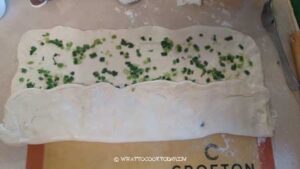
- Then fold the long side of the top third over
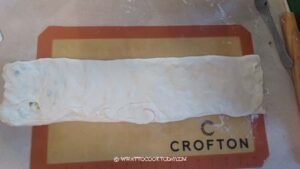
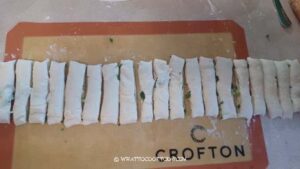
- Use a bench knife to cut the dough into 24 equal pieces
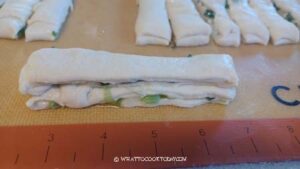
- Grab one piece of the dough and then stack the second one on top.
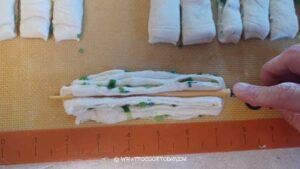
- Use a chopstick to press the dough down lengthwise
- Now grab both ends of the dough and gently pull the dough longer, about 8 inches, as you twist at the same time (refer to the short video)
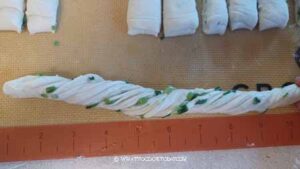
- Coil the dough to form a circle
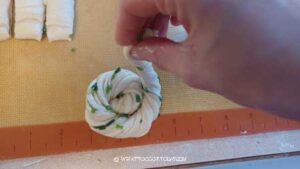
- Tuck the end underneath. Place on a small piece of parchment paper. Repeat with the rest of the dough. You will get 12 pieces
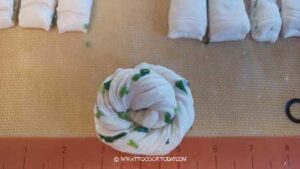
- Keep the flower shaped dough cover with a cloth and let them rise until about 50% of its original size, may take about 30 minutes or longer.
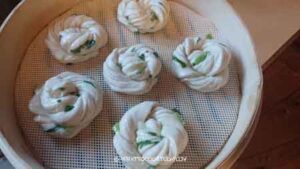
- They won't double in size, but they should look puffy and airy then before
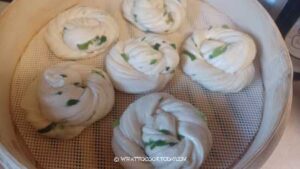
- Bring the water in your steamer to a rolling boil. Wrap the steamer's lid with a cloth (not needed with bamboo basket)
- LOWER THE HEAT TO MEDIUM. Place the buns in there, leaving about 1-inch space in between. Steam on medium heat for 12 minutes.
- After 12 minutes, turn off the heat and let them sit for another 5 minutes so the steamed buns won't shrink due to sudden temperature change. Remove from the steamer
- Continue to steam the next batch and refill the water in the steamer if needed. If you have to refill the water, make sure they come to a boil before you put the buns in to steam
- Serve them warm as is, or you can pan fry the bottom to crisp them up for the contrast of texture
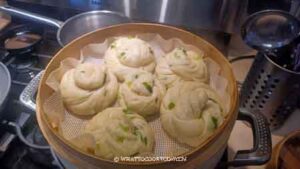
- Simply reheat about 1 Tbsp of oil on a large non-stick pan over a medium heat. Place 4-5 steamed hua juan on the oil and let them cook for about 2-3 minutes or until nicely golden brown and crispy on the bottom
- Place the pan-fried hua juan on the serving platter with the crispy side up to maintain the crispness. Serve immediately

10 comments
Awesome! Thanks for posting this recipe! I tried my hand at it and while I did need to use a bit more than the 150mL of milk suggested in the recipe, the final product was fantastic! I hand kneaded and during that time I contemplated why I didn’t invest in a stand mixer yet haha. The buns were soft and fluffy! I’m so glad I found your site with so many recipes to try!
Hi Jen, it’s tough job doing hand kneading LOL! you did good that the buns turn out soft and fluffy. Yes, the 150 ml is just a starting amount and you will add more as needed. I’m glad you like. Thank you for letting me know!
Hello! This looks delicious! I was wondering if these buns would be suitable to use with filling as well? Like in char siu filling from your Instant Pot Chinese Steamed Buns? Would the cook time be the same as the other recipe, or does the addition of green onion make any difference? Thank you!
Hi Stina, Yes these buns can be used with sweet or savory filling as you wish and the addition of green onion doesn’t make any difference to the cooking time. I hope this helps.
Thanks for the recipe. I finally got to try it but the bun was not as soft as it should be. Would you know why the case ? Perhaps my kneading skill or the flour?? appreciate any suggestions from anyone.
Hi Bibby, was the buns dense in texture? If it was, maybe you didn’t let the steamed buns proof long enough. We don’t want to overproof the buns, but we still want it to puff up to about 50% of its original size and the buns should feel lighter when you lift them up.
Made these today and they turned out wonderfully fluffy and fragrant! I kneaded by hand (as I don’t have a stand mixer) and steamed them. It was a delicious use of the spring onions growing in our backyard!
Thanks for the detailed recipe, will definitely male them again 😊
Hi Renee, I’m so glad to know that they turned out great for you. Kudos for kneading by hands 🙂 Using homegrown spring onions are even better! I wish I have some homegrown spring onion! Thank you for trying and for your feedback 🙂
These flower buns look simply delicious! The ingredients remind me of the scallion pancakes, I know I will like them. I think I want to try the pan method. I hope that mine turn out smooth, haha. I am still gaining experience with steaming buns, but definitely moving in the right direction after each try. Great recipe – thank you for all the details.
Steamed buns can be quite finicky. Just make sure you steam on LOW heat and they will most likely turn out smooth for you. The pan fried method should be “easier”. It’s like making pot stickers 🙂