This post may contain affiliate links. Please read our disclosure policy.
Learn how to make Vietnamese bun rieu cua, a comforting crab noodle soup with a savory tomato broth, tender crab and pork clusters, fried tofu, and fresh herbs.

Bún riêu cua is a traditional Vietnamese noodle soup that originated in northern Vietnam, particularly associated with the Red River Delta and Hanoi. It is a humble, everyday dish with roots in Vietnam’s rice-growing countryside, where freshwater crabs, known as cua đồng, were readily available in rice paddies and waterways.
Traditionally, people clean and pound the small freshwater crabs, shells and all, into a paste. The paste is then mixed with water and strained to extract the crab liquid. When gently heated, the crab proteins naturally gather and form soft, delicate clusters that rise to the surface of the broth. These clusters are called riêu, and they are what give the soup its name.
Tomatoes are another important component of bun rieu. They lend the broth a pleasant acidity and subtle sweetness that balance the savory crab flavor. Fermented shrimp paste (mắm tôm) is also commonly served alongside the soup or stirred into the broth to give it that distinctive depth of flavor.
As bun rieu spread across Vietnam, different regions developed their own interpretations. Northern versions tend to be more restrained, allowing the freshwater crab flavor to take center stage. Southern versions, particularly those found in Saigon, are often more generously topped with ingredients such as fried tofu, pork blood, pork knuckles, Vietnamese sausage, and sometimes snails. The exact toppings and broth seasonings vary from cook to cook.
What I love about bun rieu is that it offers something quite different from other Vietnamese noodle soups. It isn’t a rich, aromatic beef broth like pho, nor is it the spicy, lemongrass-infused broth of bun bo Hue. Instead, it has a lovely savory and slightly tangy tomato broth, delicate crab clusters, and plenty of fresh herbs and vegetables to go alongside it.
My version of Bun Rieu Cua is simplified
Traditionally, making bun rieu is a lot of work. Making the broth from scratch. Making the crab paste from scratch. I mean…everything is from scratch. That’s how grandmas cook back in the old days 🙂 I simplified this bun rieu cua recipe by:
1. Using store-bought broth
Traditionally pork bones are used to prepare the broth. It’s not overly complicated to prepare bone broth, but I find that store-bought organic bone broth is an acceptable substitute too and that’s what I used in this recipe
2. Using store-bought crabmeat paste (gia vi cua nau bun rieu)
It’s a lot of work trying to make the crabmeat paste from scratch. Most people will use store-bought crabmeat paste these days. I use store-bought crabmeat paste in this recipe
Ingredients and Substitutions
- Rice vermicelli noodles: I use dried rice vermicelli. Cook them according to the package instructions. Fresh Vietnamese bún can also be used if available.
- Chicken broth: Chicken broth provides a flavorful base for the soup. Bone broth works nicely too. You can use homemade broth or good-quality store-bought broth.
- Roma tomatoes: These give the broth its characteristic tangy flavor. Roma tomatoes hold their shape nicely when simmered, but other ripe tomatoes will work.
- Fried tofu puffs: These little tofu puffs absorb the flavorful broth beautifully. Cut larger pieces into smaller, bite-size pieces.
- Lump crabmeat: I use lump crabmeat for a generous amount of crab flavor and texture. Fresh or pasteurized crabmeat can be used.
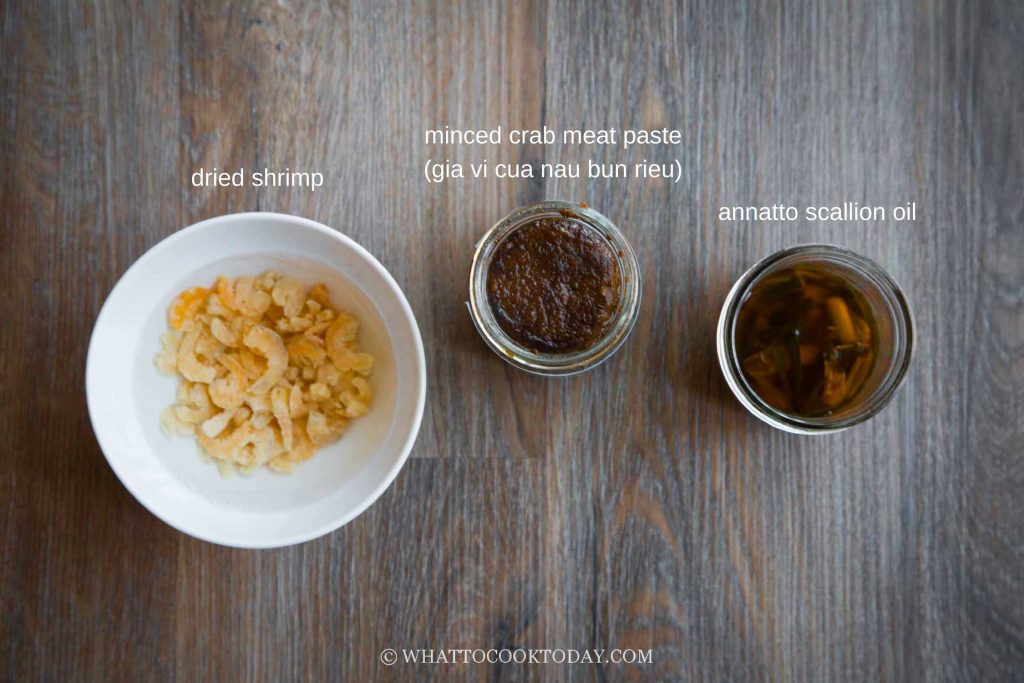
- Vietnamese crabmeat paste (gia vị nấu bún riêu): This is a seasoned crab paste commonly used to make bun rieu. It adds a concentrated crab flavor and helps give the mixture its characteristic taste. Different brands can vary in saltiness, so adjust the fish sauce accordingly.
- Ground pork: Preferably with some fat. You can also use ground chicken or turkey if that’s what you prefer
- Dried shrimp: Soaking and finely chopping dried shrimp adds another layer of savory seafood flavor. Don’t skip this if you can help it!
- Eggs: Eggs bind the crab mixture together and help it form tender clusters when cooked in the broth.
- Annatto seeds: These are used to make annatto oil, which gives the soup its beautiful orange-red color. They are mainly for coloring and do not contribute a strong flavor.
- Cooking oil: Use a neutral cooking oil for the annatto oil.
- Green onions: These are added to the hot annatto oil for fragrance.
- Fish sauce: Fish sauce seasons the broth and gives it a savory depth. Add gradually and adjust to your taste.
- Sugar: Just a little sugar balances the savory and tangy flavors. The broth should not taste sweet.
- Bean sprouts: Serve these fresh on the side for a little crunch.
- Vietnamese perilla (tía tô) and Vietnamese balm (kinh giới): These herbs are wonderful accompaniments to bun rieu. They add freshness and fragrance to the soup.
- Lime wedges: A squeeze of lime brightens the broth.
- Fermented shrimp paste (mắm tôm): This is optional but highly recommended for anyone who enjoys its distinctive savory flavor. Start with a small amount and adjust to your liking.
- Split water spinach stems: These are a lovely traditional accompaniment, although I don’t use them in this particular recipe.
Tips for Making the Best Bun Rieu Cua
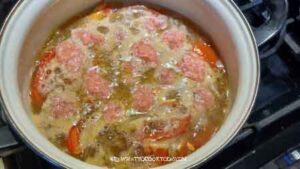
- Don’t let the broth boil vigorously after adding the crab mixture. A gentle simmer helps the crab mixture set into tender clusters without breaking apart.
- Taste the broth before and after adding the crab mixture. The Vietnamese crabmeat paste can vary in saltiness depending on the brand, so you may need to adjust the amount of fish sauce.
- Don’t overcook the tomatoes. I like them tender but still holding their shape rather than completely breaking down into the broth.
- Make the annatto oil ahead of time. It is a simple step that makes a big difference in the appearance of the finished soup. Refrigerate it promptly and use within 4 days.
Frequently Asked Questions
1. What does bun rieu cua mean?
Bún refers to rice vermicelli noodles, while riêu refers to the soft clusters of crab mixture that form when the crab proteins cook in the broth. Cua means crab. Together, bun rieu cua refers to Vietnamese crab noodle soup.
2. Can I use fresh freshwater crabs instead of canned crabmeat?
Absolutely! Fresh freshwater field crabs are traditionally used to make bun rieu. They are cleaned, pounded, mixed with water, and strained to extract the crab liquid. The liquid is then gently heated until the crab proteins form delicate clusters. This is a more traditional preparation, but it requires extra work and access to fresh freshwater crabs.
3. Can I use imitation crabmeat?
I wouldn’t recommend it as the first choice. Imitation crabmeat has a different texture and flavor from real crabmeat. If you want a more pronounced crab flavor, use real lump crabmeat and Vietnamese crabmeat paste.
4. What is the difference between Vietnamese crabmeat paste and fermented shrimp paste?
They are two different ingredients. Vietnamese crabmeat paste (gia vị nấu bún riêu) is a seasoned crab product used in the crab mixture to give it a concentrated crab flavor. Fermented shrimp paste (mắm tôm) is a fermented condiment with a strong aroma and savory, salty flavor. It is commonly served alongside bun rieu and added according to personal preference.
5. Can I make the crab mixture ahead of time?
You can prepare the crab mixture a few hours ahead and keep it covered in the refrigerator until ready to cook. Since it contains fresh crabmeat and eggs, keep it refrigerated and cook it thoroughly before serving.
6. What other toppings can I add to bun rieu?
There are many variations! Depending on the region and personal preference, bun rieu can include Vietnamese pork sausage (chả lụa), pork blood cubes (huyết), pork knuckles, snails, or even fried fish cakes. Fried tofu, however, is one of my favorite additions.
7. Can I make bun rieu without fermented shrimp paste?
Yes. The shrimp paste is usually served on the side, so everyone can adjust the amount to their liking. The soup will still be flavorful without it, especially with the crabmeat paste, dried shrimp, and fish sauce in this recipe.
How to Store and Reheat Bun Rieu
- Refrigerator: Store the broth, crab clusters, tomatoes, and tofu in an airtight container in the refrigerator for up to 3 days. Keep the cooked noodles in a separate container.
- Reheating: Reheat the broth and toppings gently in a saucepan over medium heat until thoroughly heated. Avoid stirring too vigorously, as the crab clusters can break apart.
- Freezing: The broth and crab clusters can be frozen, although the texture of the tomatoes and tofu may change slightly after thawing. I recommend freezing the broth and toppings without the noodles.
- Serving leftovers: Cook or portion fresh noodles and ladle the reheated broth and toppings over them just before serving.


Ingredients
Method
- Pour oil and annatto seeds in a medium-size skillet. Cook over medium heat until the color of the oil starts to pick up the orange hue from the seeds, about 5 minutes. Turn off the heat. Strain the oil into a heat-proof container, discard the seeds. Add the chopped green onions (you will hear sizzling). Let it cool down completely and then keep in the refrigerator for up to 1 month
- Cook the rice vermicelli noodles according to instruction and set aside
- Soak the dried shrimp in hot water until softened, about 15 minutes. Discard water and place the shrimp in mini food processor and finely chop them. You can chop them with a knife too

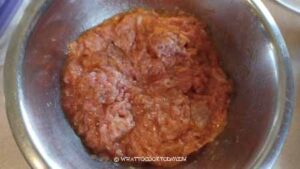
- In a large mixing bowl, add ground pork, chopped dried shrimp, crab meat lumps, eggs, crab meat paste. Stir to mix everything
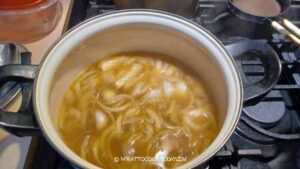
- Preheat a large pot over mediu heat with 1 Tbsp of oil. Add the sliced onion and saute for about 3-4 minutes, until they are soft and lightly colored. Add the broth and seasonings
- Add tomato quarters and lower the heat to let it gently simmer for about 1 minute.
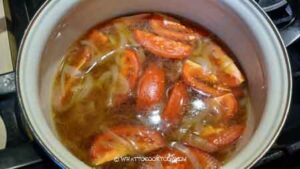
- Use a spoon and spoon a heaped tablespoon of the crabmeat mixture into the broth.
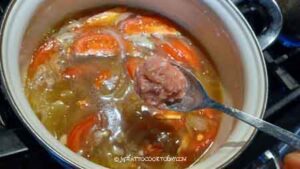
- Continue to do so until you run out of the crab meat mixture. They will sink to the bottom and float to the top once cooked. Have a taste and adjust by adding more fish sauce, and/or sugar. It should be savory with just a hint of sweetness. Don't hardboil the mixture so they won't fall apart in the broth
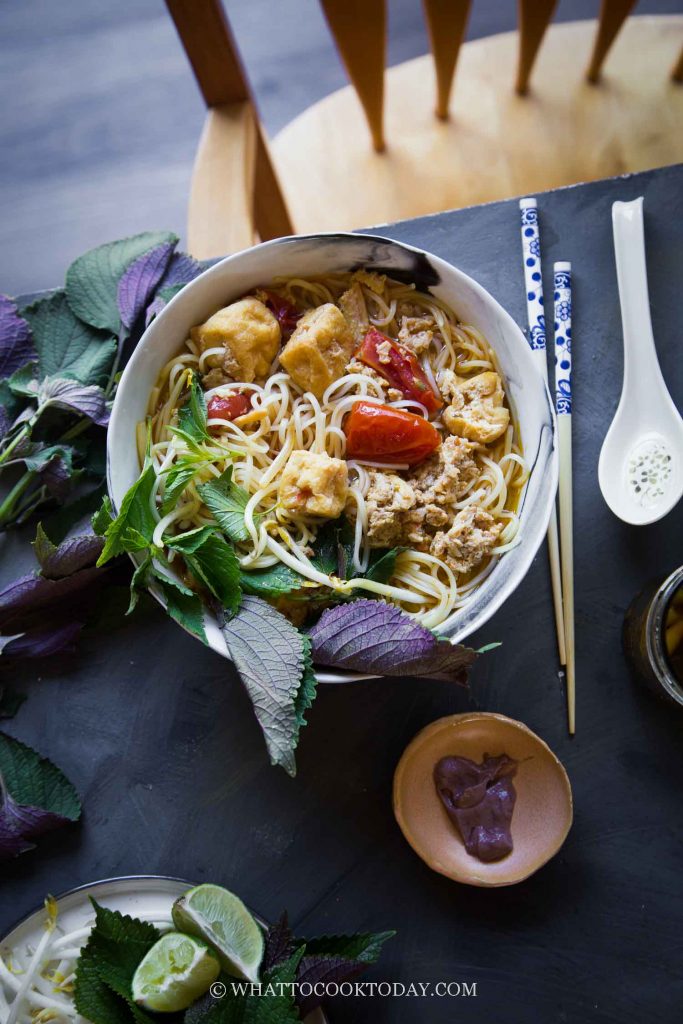
- Portion the cooked noodle into an individual serving bowl. Ladle the crab meat, tomatoes, fried tofu puffs and hot broth over the noodles generously. Drizzle some annatto scallion oil over the noodles. Serve with fresh Vietnamese balm leaves, tia to, bean sprouts, lime wedges, and shrimp paste on the side. Serve immediately

2 comments
Hi Marvellina
You missed out the ground pork in preparing the crab meat mixture.
Ivy
Hi Ivy! oopss! Thank you for letting me know!!! I’ve amended it accordingly!